impaQt: Developing Climate-Resilient Urban Districts Together
We are delighted to see the EU LIFE project impaQt featured by the Austrian Research Promotion Agency (FFG) as one of its Success Stories.
A Holistic Approach to Climate-Resilient Neighbourhoods
How can existing urban districts be adapted to climate change across property boundaries, land ownership, and institutional responsibilities? This is the key question addressed by impaQt, a project funded under the EU LIFE Programme.
The project’s objective is to transform urban neighbourhoods through a holistic approach, bringing together research, public authorities, businesses, and civil society to implement measures that strengthen climate resilience.
Rather than focusing on individual sites, impaQt considers the entire neighbourhood – including both public and private spaces – as one integrated system. Climate adaptation measures such as reducing sealed surfaces, creating green spaces, and storing rainwater are combined with climate mitigation actions including resource-efficient construction, local renewable energy generation, and shared heating solutions.
Looking at neighbourhoods as interconnected systems creates synergies and enables multiple interventions to reinforce one another. This approach also allows financing to be organised more efficiently. As part of the project, innovative financing mechanisms – such as an Eco-Social Urban Transformation Bond – are being developed, tested, and implemented.
New Models of Collaboration
A central objective of impaQt is to jointly plan climate-resilient urban development across sectors, property ownership, and administrative responsibilities. This includes the implementation of nature-based solutions, as well as sustainable energy and mobility concepts.
To achieve this, the project is developing new organisational models that enable cooperation across property and ownership boundaries. In Austria, this takes the form of a publicly-private organised “Grätzltransformer” (neighbourhood transformer), while in Germany the equivalent “Kieztransformer” model is being established.
In parallel, the project is creating financing mechanisms that support the transformation of entire urban districts by combining public and private investment.
The evaluation methods, planning tools, and financial, legal, and organisational approaches developed and tested in the pilot areas of Melk (Austria) and Berlin (Germany) are intended to support many other cities and municipalities in making their neighbourhoods more climate-resilient, liveable, and financially viable.
European Cooperation as the Key to Success
The project is coordinated by Green4Cities together with the following Austrian and German partners:
- Green4Cities GmbH (Coordinator)
- Energy and Environment Agency of Lower Austria (eNu)
- University of Natural Resources and Life Sciences, Vienna (BOKU)
- Roland Honeder Tax Consulting
- superwien urbanism zt gmbh
- City of Melk
- European Federation of Green Roof and Living Wall Associations (EFB)
- Komobile GmbH
- Plan Zwei – Urban Development, Urban Research & Communication
- District of Berlin Charlottenburg-Wilmersdorf
A major added value of the EU funding is that it enables the diverse expertise required for transforming existing urban districts to be brought together with sufficient time and quality. This allows integrated planning across properties, together with legal, organisational, and impact-based financing solutions, to be developed collaboratively with all relevant local stakeholders.
Patrick Strobl, Mayor of the City of Melk, highlights the project’s significance:
“Through this project and the support provided, Melk has the opportunity to position itself as a pioneer in climate-resilient and economically sustainable urban development.”
From Melk to Berlin
The project includes tangible demonstration activities in both Austria and Germany.
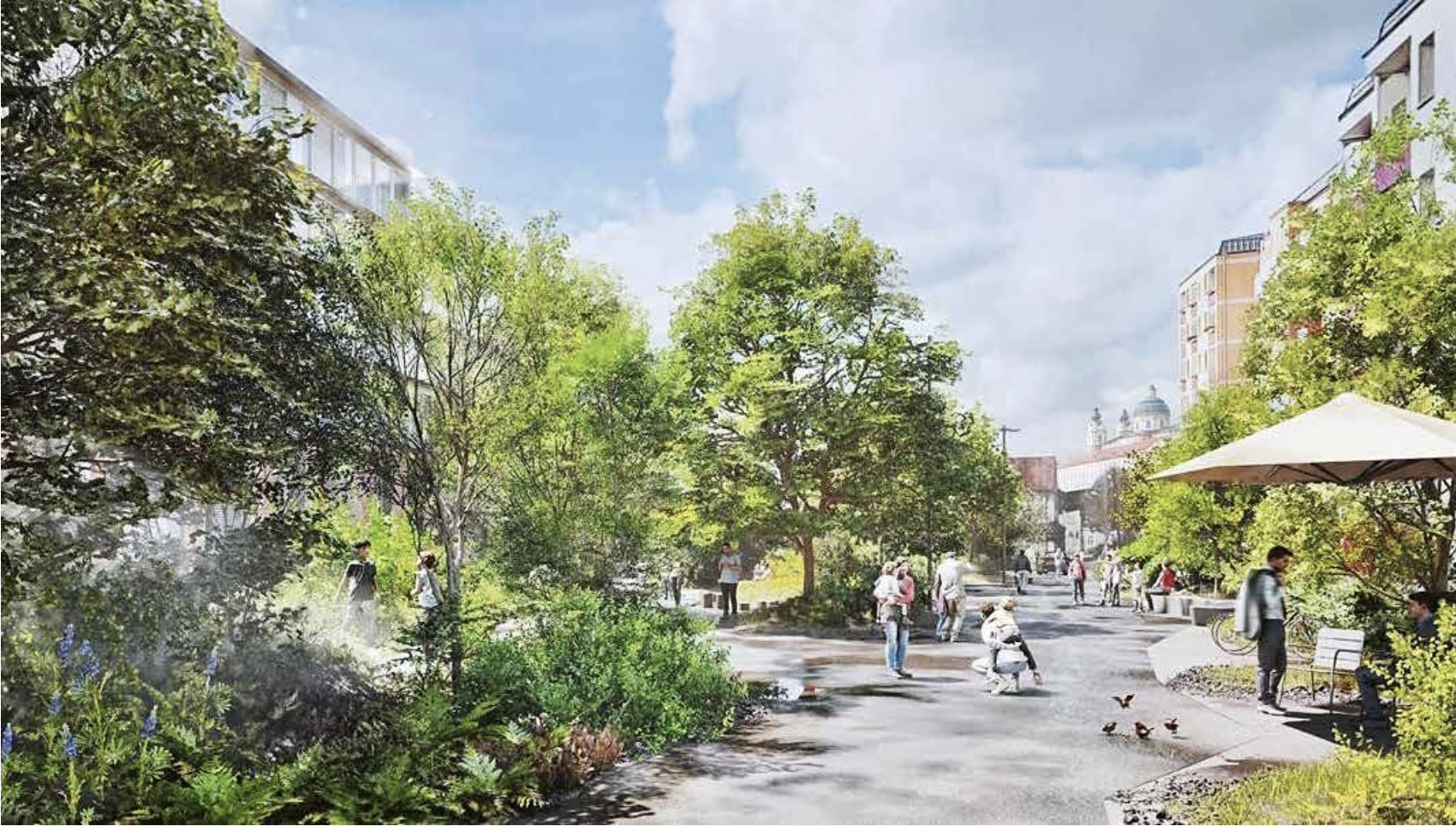
In Melk, a public parking area will be transformed into an attractive urban garden offering high-quality public space. Together with the neighbouring mixed-use private properties, it will form the new “Climate Boulevard”. Construction of the urban garden is scheduled to begin in autumn 2026.
In Berlin, the project will implement the Ilsenburger Straße Rainwater Self-Sufficient Street, a flagship initiative supporting the sustainable development of the Mierendorfer Island district in Charlottenburg-Wilmersdorf.
Through the methods, planning tools, and financing approaches developed within the project, impaQt will create practical solutions that can be replicated by cities and municipalities across Europe to support climate-resilient neighbourhood development.
Project Information
| Funding Programme | EU LIFE Programme |
| Project Title | impaQt |
| Funding Strand | LIFE Climate |
| Project Type | Standard Action Project (SAP) |
| Total Budget | €5,148,888 |
| EU Contribution | €3,089,332 |
| Project Duration | 1 August 2025 – 31 July 2029 |
| Project Coordinator | Green4Cities GmbH |
| Project Coordinator Contact | Doris Schnepf |
| doris.schnepf@green4cities.com | |
| Project Website | https://webgate.ec.europa.eu/life/publicWebsite/project/LIFE24-CCA-AT-impaQt-101213931/impaqt-climate-resilient-cities-cross-siloed-impact-of-urban-city-quarters |